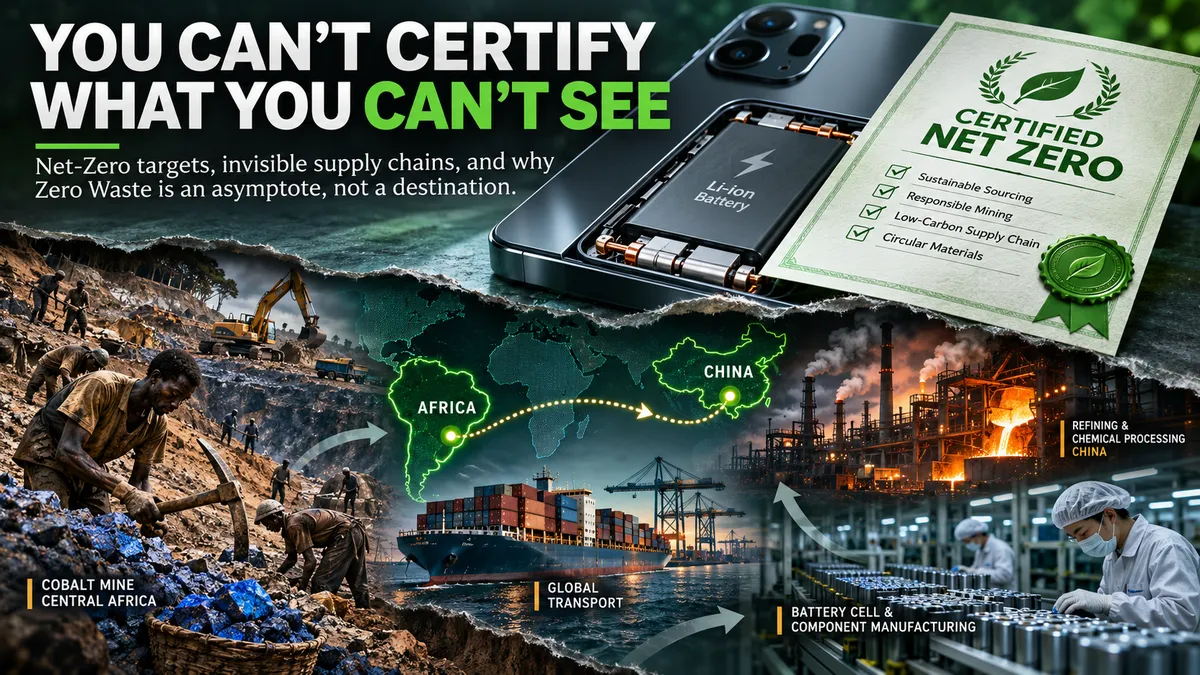
You Can't Certify What You Can't See
Net-Zero targets, invisible supply chains, and why Zero Waste is an asymptote, not a destination.
Your favorite brand probably has a Net-Zero target.
Ask it a simpler question.
Where did the cobalt in your phone battery come from? Which mine. Which refinery. Which power grid ran the furnace. Where will that cobalt be in fifteen years?
Most brands can't answer.
Some can answer part of it. Very few can answer all of it with evidence.
And yet the report is glossy, the targets are dated, and the product page says "responsibly sourced."
I've worked in waste management since 2009. I trained as a chemist. I've evaluated treatment plants from Azerbaijan to the Republic of the Congo, and developed recovery projects across Europe and Africa.
My job has always started where the marketing ends: with the actual material. What it is made of. What contaminates it. What it costs to separate. Who will buy what comes out the other side.
That habit makes me suspicious of one kind of sentence more than any other. The sentence that claims total control over something nobody has fully measured.
This is not an article about dishonest companies. Most Net-Zero targets are legitimate ambitions, set in good faith, built on accepted accounting rules.
This is an article about the gap between a target and proof. And about why that gap is getting more expensive every month.
How the Factory Disappeared
On December 11, 2001, China joined the World Trade Organization.
It was not the only cause of what came next. Container shipping, cheap capital, falling communication costs and shareholder pressure on margins all pushed the same way. But accession accelerated a decision thousands of Western boardrooms were already making: stop making things, start managing the people who make them.
The logic was sound. Lower costs. Faster scale. Contract manufacturers who could build almost anything.
The side effect was quiet. The brand owner moved from the factory floor to the purchase order. The company that sold you the product was no longer the company that smelted, refined, plated, molded or assembled it. Often it did not even choose who did.
Between 2009 and 2015 the volume exploded. Smartphones. Laptops. Lithium-ion batteries. Data centers. Every device carried a small inventory of the periodic table: cobalt, lithium, nickel, copper, tantalum, tin, gold, rare earths.
Each of those elements travels its own route. And that route has stages most consumers never separate.
Where the ore is mined. Who owns the mine. Where it is refined. Where the component is made. Where the product is assembled. Where it is sold.
Potentially six locations. Six regulatory regimes. Six energy mixes. Six waste streams.
The consumer sees one logo.
The Invisible Factory: Follow One Battery
Take the cobalt in a lithium-ion battery.
The U.S. Geological Survey estimates the Democratic Republic of the Congo mined about 73% of the world's cobalt in 2025. Indonesia was a distant second, at roughly 14%.
But the USGS also notes that China, not Congo, is the world's leading cobalt refiner. The International Energy Agency puts China's share of cobalt refining at around three quarters.
So the cobalt in your battery may have been dug in Katanga, shipped as hydroxide, refined in China, converted into cathode material, built into a cell in Asia, packed into a module somewhere else, and sold under a European or American brand.
Every step generates its own emissions and its own residues. Tailings. Acidic process water. Slag. Spent reagents. Packaging.
Now add the provenance problem.
Congo's copper-cobalt belt includes large industrial mines run by international companies with formal environmental systems. It also includes artisanal and informal extraction, where documentation can be thin and material can be mixed before it reaches a trader.
Once ore from different sources is blended and chemically transformed, physical tracing gets much harder. Refined cobalt sulfate does not carry a passport.
This is not a statement about Congo or China as countries. China runs some of the most advanced refining and recycling operations on the planet. Industrial mines in Congo can be audited, and many are.
The issue is narrower, and more uncomfortable.
Can the brand at the end of the chain demonstrate what happened at every relevant step? Or does it rely on declarations passed up the chain by suppliers it has never visited?
The Promises Got Louder. The Leverage Got Real.
The Paris Agreement in 2015 changed the corporate vocabulary. ESG investing. Science-based targets. Carbon-neutral labels. Net-Zero by 2040, by 2050.
Environmental ambition became a commercial asset. It moved valuations and won tenders.
Then the pandemic hit. Supply chains that looked like straight lines on a slide turned out to be webs nobody had fully mapped. Companies discovered they depended on sub-suppliers they could not name.
The energy crisis and the war in Ukraine taught a second lesson. Physical resources are not a footnote in the procurement file. They are leverage.
By 2025 that lesson became policy.
In February 2025, Congo suspended cobalt exports to stop a price collapse. In October it replaced the ban with quotas: 96,600 tonnes a year for 2026 and 2027, roughly half of 2024 volumes. Glencore's Congolese cobalt output fell 39% in the first quarter of 2026 as it pivoted to copper and stored above-quota material in the country.
China moved too. Seven rare earths have needed an export license since April 2025. In October 2025 Beijing announced a far wider package: five more rare earths, battery materials, processing technology, and a rule reaching foreign-made products containing as little as 0.1% Chinese-origin rare earth content by value.
After the Busan summit, that package was suspended until November 10, 2026.
I'm writing this on November 5, 2026. That date is five days away.
Washington says the wider truce now runs to January 10, 2027. Beijing confirmed the broader arrangement in late September. But as of this week, no formal Chinese notice has amended the rare-earth suspension itself.
Read that again. The magnet, motor and battery supply of every manufacturer outside China hinges on a document that may or may not be published.
The IEA's 2026 Critical Minerals Outlook put a number on the exposure. Full enforcement of China's rare-earth controls could put about $6.5 trillion of annual production outside China at risk. And excluding rare earths, the average share of the top refining country across key energy minerals rose from 70% in 2023 to 72% in 2025.
Diversification is happening. It is slow. On average, refining concentration is still rising.
Here is the point for every Net-Zero team reading this. If a company cannot guarantee it will receive a material, how confidently can it describe the conditions under which that material was produced?
Scope 3: Where Precision Meets Estimation
Corporate carbon accounting splits emissions into three scopes.
Scope 1 is what you burn directly. Scope 2 is the electricity and heat you buy. Scope 3 is everything else in your value chain: mining, refining, components, transport, use, end of life.
For most makers of physical goods, Scope 3 is the majority of the footprint. It is also where measurement is weakest.
The GHG Protocol allows several methods. Supplier-specific data. Average data. Industry emission factors. And spend-based estimates, which multiply dollars spent by an average emissions intensity for that category.
These methods are legitimate. Nobody could build a Scope 3 inventory if every supplier had to be metered directly. A credible inventory doesn't need that. It needs honest disclosure of coverage, assumptions and uncertainty.
Estimation is not fraud. But estimation is not traceability either.
A spend-based number tells you what a typical supplier in that category might emit per dollar. It does not tell you what your actual refinery emitted. It cannot tell you where the tailings went.
The standard-setters know this. In March 2026 the GHG Protocol published its first progress update on revising the Scope 3 Standard, the first substantive overhaul since 2011. The proposals include reporting at least 95% of required Scope 3 emissions, and breaking the figures down by data type: supplier-specific, secondary or spend-based.
Think about what that means. The people who wrote the rules want companies to show how much of their number is measured and how much is modeled.
Regulators are moving faster. Since September 27, 2026, the EU's Empowering Consumers
Directive treats product claims like "carbon neutral" as unfair practices when they rest on offsetting outside the product's value chain. Generic claims like "eco-friendly" now need recognized proof.
Certifications and third-party audits help. But an audit verifies what it is scoped to verify. A certificate on a final product says little about a mine three tiers upstream that no auditor visited.
So here is the question the market has avoided for twenty years.
If you cannot identify and verify the operations behind your raw materials, what exactly are you certifying?
There is a spectrum here. A verifiably false declaration. A misleading presentation. A poorly supported claim. A sincere target that remains uncertain. They are not the same thing, and lumping them together helps nobody.
But the consumer reading "fully sustainable" on a box doesn't see the spectrum. They see a promise of control. And control is exactly what most complex supply chains can only partially document.
That is the difference between industrial accountability and the appearance of it.
The Zero Waste Asymptote
Now let's go one level deeper. Below the accounting. Into the physics.
In mathematics, an asymptote is a line a curve approaches without necessarily reaching it. Every step gets closer. The gap shrinks. It does not have to close.
That is how I model material recovery.
Every serious improvement moves the curve up. Better product design. Cleaner segregation at source. Better sorting. Higher yields. Less contamination. Secondary raw materials fed back into manufacturing. I've spent my career helping operators climb that curve. It pays.
But physical reality sets limits that slogans ignore.
Mass is conserved. Value is not. Every atom you put into a product still exists at end of life. The question is where, in what form, mixed with what. Copper in a cable is a resource. The same copper spread across ten thousand shredded circuit boards, alloyed, plated and coated, is a separation problem.
Dispersion is free. Concentration is expensive. This is the Second Law at work. Mixing happens on its own. Unmixing costs energy, reagents, equipment and time. The more dilute the target, the more energy per kilogram you recover. Past a certain point, recovery costs more than it returns, in money and often in emissions.
Materials degrade. Polymers lose chain length each time they are reprocessed. Metals pick up tramp elements that are hard to remove. Paper fibers shorten. Quality falls until the material drops out of the high-value loop.
Composites resist separation. A battery pack, a laminated pouch, a multilayer circuit board. Designed for performance, not disassembly.
Some losses are dissipative by nature. Wear particles, corrosion, pigments, coatings, additives released during use. They leave the system before anyone can collect them.
None of this means recycling is futile.
Thermodynamics does not forbid recovery. It prices it.
Recovery is possible, often profitable, and frequently the smartest industrial move available. What thermodynamics rules out is the fantasy of infinite, lossless loops at zero energy cost.
The field data shows how far we still are from the ceiling. The UN's Global E-waste Monitor found that only 22.3% of the world's e-waste mass in 2022 was documented as formally collected and recycled. E-waste recycling covered about 1% of rare earth demand.
Most of that gap is collection, economics and policy, not physics. But it shows why the word "zero" should make any engineer nervous.
So I draw a line between two uses of the same words.
"Zero waste" as a management target, a direction, a discipline for measuring progress, is useful. I support it.
"Zero Waste" as a physical state, where every material is recovered indefinitely without loss, is not a description of industrial processes. It is a slogan wearing a lab coat.
The asymptote is a conceptual model, not a universal law with a fixed number attached. But it is the honest model. It changes what you manage. You stop chasing a finish line and start managing the gap.
From Waste Management to Resource Management
If Zero Waste is the wrong destination, what is the right one?
Not "recycle more." A recycling percentage is an output metric. It tells you nothing about the purity, quality or market value of what came out.
Linear thinking says extract, make, use, dispose. Conventional circular thinking says reduce, reuse, recycle, recover.
What I argue for is strategic natural resource management. Knowing what a material is, where it came from, how it was transformed, what its recovery potential really is, and where it re-enters production.
It's the same logic behind the SAM Method I use with operators: control the stream, and you control the output.
In practice, that means six disciplines.
Know your materials before they enter production, not after they become waste.
Push accountability down the supplier tiers that actually matter, starting where emissions and provenance risk are highest.
Design products with recovery pathways that work in real plants, not in brochures.
Recover what has value, without pretending technical limits don't exist.
Put secondary raw materials back into manufacturing when quality and economics allow.
Document what cannot be recovered. Publish the residual. Stop hiding it behind a slogan.
The last one is the most radical.
It is also the most credible thing a company can do.
This is not a guilt argument. It's an economic one.
With Congo rationing cobalt and Beijing holding the licensing pen on rare earths, every kilogram of critical material a company can recover, verify and reuse is a kilogram it doesn't have to negotiate for. Material intelligence has become supply security.
The companies that win the next decade won't be the ones with the boldest targets. They'll be the ones who can show their work.
The Question You Should Keep Asking
Zero Waste sounds like a destination.
In industrial reality, it's an asymptote.
The closer we get, the more we see what we haven't measured, can't yet recover, or chose not to disclose.
That's why I wrote The Zero Waste Lie.
Not to tell you what to believe. To put the physics, the chemistry and the economics back underneath the promises, so you can judge any claim on your own terms.
If you sell products, it will show you where your claims are exposed.
If you run a waste or recycling business, it will show you why the residual is where your margin and your credibility are decided.
If you invest, it will give you sharper questions than any rating agency will.
The marketing will keep getting louder. The physics won't change.
You can keep trusting the label. Or you can learn to read what's underneath it.
Get your copy of The Zero Waste Lie → https://bit.ly/4k47z8J
Sam Barrili
The Waste Management Alchemist