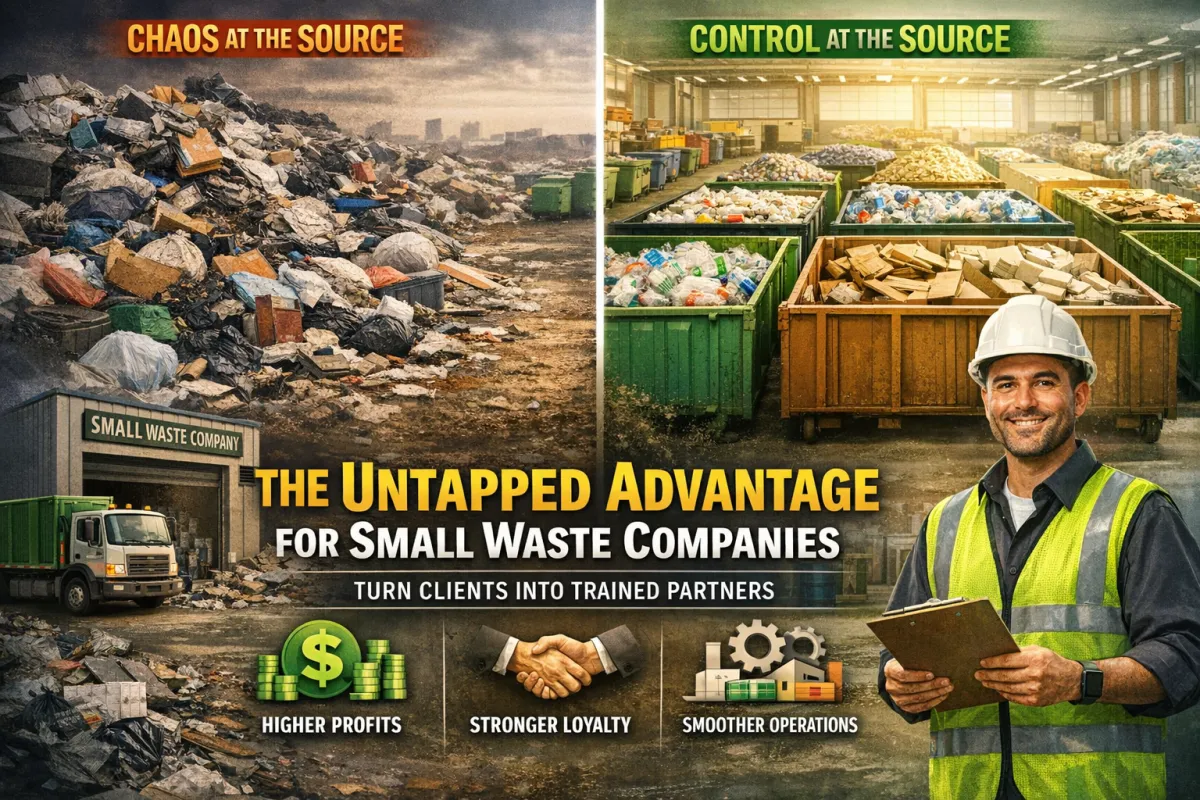
The Hidden Lever Inside the U.S. Waste System
Why Small Waste Companies Are Sitting on an Untapped Advantage (And How to Activate It Fast)
There is a structural reality that almost nobody talks about openly.
The entire U.S. waste management system is not built on giants.
It’s built on small operators.
Local haulers.
Independent recyclers.
Family-owned waste companies.
Regional players moving material every single day.
They are the ones collecting, transporting, sorting, and—most importantly—deciding the fate of waste streams across the country.
And yet…
Most of them are leaving money, control, and long-term positioning on the table.
Not because of lack of effort.
Not because of lack of clients.
But because of one critical blind spot:
They don’t control how waste is generated at the source.
The Real Problem Isn’t Collection
Most small waste companies think their business is about:
picking up waste
optimizing routes
reducing landfill costs
increasing volumes
That’s the traditional model.
And that model is getting tighter every year.
Margins are compressed.
Fuel costs fluctuate.
Labor is harder to find.
Landfills are more expensive.
Compliance is heavier.
So what happens?
Operators push for more volume to compensate.
More trucks.
More pickups.
More pressure.
But here’s the uncomfortable truth:
Volume without control doesn’t increase profitability. It increases complexity.
And complexity kills margins.
The Missing Piece: What Happens Before You Arrive
Let’s be brutally honest.
By the time you pick up waste from a client…
The game is already decided.
Because that waste has already been:
mixed
contaminated
downgraded
stripped of value
And you’re left managing the consequence.
Not the opportunity.
This is why two companies collecting the exact same waste type can have completely different results.
One makes money.
The other pays to get rid of it.
The difference?
Upstream control.
Small Companies Don’t Know What They’re Throwing Away
Here’s the reality on the ground:
Your clients - restaurants, workshops, offices, HVAC companies, small manufacturers - do not understand waste.
Not strategically. Not economically.
They see:
“trash”
“something to remove”
“a cost to minimize”
So what do they do?
They mix everything.
Plastic with organic.
Metals with general waste.
Hazardous with non-hazardous.
Not because they want to create problems…
But because nobody ever showed them a better way.
And this is where your biggest opportunity is hiding.
The Shift: From Waste Collector to Waste Controller
If you want to grow in today’s market, you need to make a shift.
A strategic one.
You must move from:
“I collect waste”
to:
“I control the quality of what I collect.”
Because the real value is not in the truck.
It’s in the material quality inside that truck.
And you don’t control that at your facility.
You control it at your client’s location.
The Most Underrated Strategy in Waste Management
Let me give you something simple.
But extremely powerful.
Start teaching your clients how to manage their waste.
Not in theory.
Not in long boring manuals.
But in short, practical, targeted training sessions.
What I call:
👉 Micro-Courses for Waste Generation Control
Why This Changes Everything
When you train your clients, three things happen immediately:
1. You Improve Material Quality
Better separation = higher value materials.
cleaner plastics
separated metals
uncontaminated streams
Which means:
better selling prices
more options
less rejection
2. You Reduce Operational Friction
When waste is managed properly at the source:
fewer errors
fewer surprises
smoother logistics
less time wasted on problem-solving
Your operation becomes predictable.
And predictability is where margins grow.
3. You Lock in Your Clients
Here’s the part most operators miss.
When you become the company that:
educates
supports
improves your client’s internal processes
You stop being a supplier.
You become a partner.
And partners don’t get replaced easily.
“But My Clients Won’t Care…”
That’s what many operators think.
And they’re wrong.
Your clients don’t care about waste.
But they care about:
saving money
avoiding problems
simplifying operations
So you don’t sell “waste training.”
You position it as:
👉 “We help you reduce costs and avoid mistakes in how you handle materials.”
Now they listen.
What These Micro-Courses Look Like
This is not complicated.
You don’t need a training academy.
You need simple, repeatable, focused content.
For example:
Module 1 — The 3 Waste Streams You Must Never Mix
Explain clearly what should be separated and why.
Module 2 — The Hidden Cost of Contamination
Show real examples of how mixed waste destroys value.
Module 3 — Simple Setup Inside Your Facility
Where to place containers.
How to label them.
How to train staff.
Module 4 — What Happens After We Collect
Give visibility. Show the process. Build trust.
Each module:
10–15 minutes
practical
visual
easy to implement
No fluff.
The Strategic Advantage Nobody Is Talking About
When you implement this system across multiple clients, something powerful happens.
You start creating:
👉 Standardized waste streams
Across your entire network.
Which means:
consistent material quality
predictable volumes
stronger negotiation power
Now you’re not just selling waste.
You’re selling:
controlled secondary raw materials.
And that changes your entire positioning in the market.
From Operator to Resource Manager
This is where small companies can leap forward.
Not by becoming bigger.
But by becoming smarter.
Because large corporations already do this internally.
But small businesses?
They depend on you.
Which means you have a unique advantage:
👉 You can influence dozens, hundreds, even thousands of waste generation points.
That’s leverage.
The Long-Term Play
If you ignore this, here’s what happens:
you keep competing on price
you deal with low-quality materials
you stay exposed to market volatility
you remain operationally stressed
If you implement this:
you improve margins
you gain control
you differentiate your company
you become harder to replace
Same market.
Different position.
The Real Reason Most Don’t Do It
Let’s be honest.
This strategy is not complex.
But it requires a shift in mindset.
You stop reacting.
You start leading.
And many operators are too busy running daily operations to step into that role.
That’s exactly why this is an opportunity.
The Companies That Move First Will Win
In the next 3–5 years, the gap will grow.
Between:
companies that collect waste
andcompanies that control material flows
The second group will dominate.
Because they will have:
better margins
stronger client relationships
more stable operations
The Question You Should Ask Yourself
Not:
“Can I implement this?”
But:
👉 “How long can I afford not to?”
Because every day your clients are mixing waste…
You are losing value.
Where This Comes From
Everything you’ve just read is not theory.
It’s part of a broader system I explain in The Waste Alchemy.
A practical framework to help you:
identify value inside waste streams
control inputs and outputs
transform your operation into a resource-driven business
Final Thought
Waste is not the problem.
Lack of control is.
And the moment you start influencing what happens before collection…
You stop chasing margins.
You start building them.
👉 If you’re ready to move from “waste handling” to “resource control,”
get your copy here: https://bit.ly/4sQt4LQ
And start seeing what others are still missing.
To Your Success
Sam Barrili
The Waste Management Alchemist