The War Economy's Invisible Price Tag: How Active Conflicts Are Depleting Critical Raw Materials — and Why Urban Mining Is the Only Rational Response
Introduction: The Battlefield Runs on Minerals
Most people analyze wars through the lens of politics, ideology, or energy. I analyze them through the lens of materials — because materials are what armies are actually made of, and materials are what waste management companies have been quietly collecting, crushing, and discarding without understanding their true value.
The wars currently burning in Ukraine, Afghanistan, and across the Iran-connected theater are not simply humanitarian tragedies. They are accelerating a structural depletion of the world's most critical raw materials — at a speed and scale that no single mining operation can replenish.
And the answer to that depletion is already sitting in your waste plant.
The 12 Defense-Critical Raw Materials — and Where They Go
In December 2024, NATO published its first-ever list of defense-critical raw materials. The list identifies 12 materials facing "high" to "very high" supply risk: aluminium, beryllium, cobalt, gallium, germanium, graphite, lithium, manganese, platinum, rare earth elements (REEs), titanium, and tungsten.
These are not abstract commodities. They are the molecular backbone of modern warfare:
Tungsten — essential for armour-piercing munitions, artillery penetrators, and missile systems. Every artillery round fired in Ukraine consumes tungsten that cannot be reclaimed.
Germanium — used in infrared sensors for missiles and surveillance systems. Germanium prices surged over 100% following the 2022 Russian invasion of Ukraine, driven by military demand.
Gallium — critical for military-grade radar, electronic warfare, and next-generation missile defense. China controls 60-90% of global processing capacity.
Cobalt — integral to rechargeable batteries in drones, guidance systems, and military vehicles. Also consumed in jet engine superalloys.
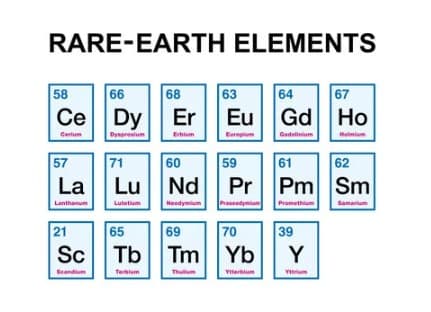
Rare Earth Elements (REEs) — used in tank navigation, missile guidance systems, fighter jet engines, satellite communications, and defense electronics.
Titanium — required in aerospace structures, the F-35 airframe, and naval vessels. Ukraine held the world's largest titanium reserves in Europe before the Russian invasion.
Lithium — powering batteries for drones, electronic warfare units, and electric military vehicles.
The critical point, which military strategists have begun to acknowledge, is that unlike fuel, many of these materials cannot be regenerated. When a Javelin missile is fired — and over 10,000 germanium-containing Javelins have been deployed in Ukraine — that germanium is destroyed. It does not return to the supply chain. It is gone.
Ukraine: A Resource War Wearing a Geopolitical Mask
Ukraine holds approximately 5% of global critical mineral reserves — over 20,000 documented deposits spanning 116 mineral types. Before the 2022 invasion, Ukraine was among Europe's top producers of titanium, graphite, manganese, and lithium, and supplied 90% of semiconductor-grade neon to the US.
Russia's strategic occupation of Donetsk, Luhansk, Zaporizhzhia, Kherson, and Crimea was not accidental. These territories host the majority of Ukraine's coal, iron, lithium, titanium, and rare earth deposits. By the end of 2022, Russia controlled between 50% and 100% of Ukraine's reserves of lithium, tantalum, cesium, and strontium — materials critical for both green energy technologies and defense production.
The war has simultaneously destroyed Ukraine's material production capacity (nearly half its power generation infrastructure has been decimated), disrupted traditional supply routes for European industry, and placed enormous pressure on Western defense stockpiles that are being consumed faster than they can be replenished.
The West is burning through its own rare earth-dependent missiles and interceptors while the Russian-controlled territory holds the very minerals needed to rebuild those arsenals. That is the strategic paradox no one in mainstream media is articulating clearly enough.
Afghanistan: The Trillion-Dollar Graveyard of Critical Minerals
The US Department of Defense memorably labeled Afghanistan "the Saudi Arabia of lithium." Pentagon estimates placed the value of Afghanistan's mineral deposits at over $1 trillion — copper, cobalt, iron ore, lithium, and an estimated 1.4 million metric tons of rare earth elements.
The Taliban, since retaking Afghanistan in 2021, has signed contracts worth $6.5 billion for extraction of gold, iron ore, lead, and zinc with Chinese, Iranian, Turkish, and UK mining firms. Chinese state enterprises have specifically targeted lithium deposits in Konar and Nurestan provinces.
The consequences for the West are severe: Afghanistan's mineral wealth, which Western nations invested over $488 million trying to help develop under responsible governance frameworks, is now flowing into the supply chains of China and other non-democratic actors. An estimated $19 million annually from rare earth smuggling finances ISIS-K Khorasan alone.
The "resource curse" is operational in Afghanistan — and every ton of rare earth that flows through Taliban-controlled channels is a ton unavailable to Western defense and green energy supply chains.
Iran and the Middle East: Precision Munitions and the Mineral Arithmetic of Modern War
The opening 36 hours of the recent US-Israeli military campaign against Iran consumed more than 3,000 precision-guided munitions and interceptors. Research from the Payne Institute at the Colorado School of Mines translated this into a mineral consumption ledger: each precision munition contains rare earths, germanium, tungsten, and other critical materials embedded in guidance systems, fuzing mechanisms, and structural components.
The lesson from Iran is the same one playing out in Ukraine: modern guided warfare is a critical mineral consumption event. The question defense planners are only beginning to ask — not how many launchers we have at the start of a war, but how many precision weapons can be fired on day 200, and how fast industry can replace them — is fundamentally a minerals-and-processing question.
Iran itself holds significant reserves of copper, zinc, and iron ore, but is structurally excluded from Western supply chains by sanctions, meaning geopolitical competition for remaining accessible CRM sources intensifies with each escalation.
The Economic Consequences: A Supply Chain Under Siege
The cumulative effect of these three theaters of conflict on global critical raw material markets is measurable and accelerating:
The global market for key green and defense transition minerals has doubled to over $320 billion in the past five years — driven simultaneously by electrification demand and military consumption.
Nickel prices surged over 100% in the first two weeks following Russia's 2022 Ukraine invasion.
Germanium prices have climbed over 100% since 2022.
China — which controls 60-90% of processing capacity for most NATO-listed defense minerals — has imposed export restrictions on gallium and germanium, two elements critical for military-grade electronics.
The US currently imports more than 95% of its rare earth consumption — mostly from China.
This creates an economic vulnerability that no mining expansion program can solve in the short or medium term. Large mining projects require decades from discovery to production. The West cannot mine its way out of this crisis in time.
But it can recycle its way out.
Urban Mining: The Alchemy That Closes the Loop
This is where my work, The Waste Alchemy, becomes directly relevant to the geopolitical analysis above — and where waste management companies have a role that extends far beyond business strategy.
Urban mining is the systematic recovery of critical and precious metals from the accumulated stockpile of discarded electronic and industrial equipment in modern societies. The concept, coined in the 1980s by Professor Hideo Nanjyo at Tohoku University, has gained enormous traction as traditional ore grades decline and supply chains fracture.
The mathematics are compelling. Consider the concentration differential:
1 ton of smartphones yields approximately 300 grams of gold.
1 ton of gold-bearing soil in a rich gold vein yields approximately 30 grams of gold.
Smartphones are ten times richer in gold than gold mines. And smartphones are already collected, already sorted, already in waste plants. The same logic applies to cobalt, tantalum, palladium, germanium, and rare earth elements embedded in TVs, computers, industrial motors, electric vehicle batteries, and defense electronics.
What Urban Mining Recovers — and What Wars Are Consuming
Let me be direct about the connection between the geopolitical analysis above and urban mining:
Every mineral that a Javelin missile, a Patriot interceptor, or a Tomahawk cruise missile consumes on a battlefield was processed from ore somewhere in the world. But the same mineral also exists — in higher concentrations — in the WEEE waste stream flowing through waste management plants today.
Germanium: Recovered from zinc smelting byproducts and from legacy electronics. Critical for infrared sensors in missiles. Prices up 100%+.
Cobalt: Recovered from lithium-ion battery recycling, EV batteries, and smartphone batteries. Critical for jet engine superalloys and rechargeable military systems.
Rare Earth Elements: Recoverable from hard drives, permanent magnets in motors and wind turbines, and fluorescent lamps. Critical for missile guidance, radar, and electronic warfare.
Tungsten: Recovered from cutting tool scrap, drilling equipment, and industrial WEEE. Critical for all munitions penetrators.
Titanium: Recoverable from aerospace scrap and industrial waste. Critical for aircraft, missile airframes, and naval vessels.
Gold, Silver, Copper: Recoverable from PCBs, wiring, and consumer electronics. All currently in structural supply deficits and/or supply crises.
The Urban Mining Opportunity for Waste Companies
The war economy is not creating the critical raw material crisis — it is accelerating an already existing structural deficit. The green energy transition, the AI hardware boom, and military rearmament are all competing for the same pool of critical minerals simultaneously.
This creates an extraordinary economic opportunity for waste management companies willing to pivot from the disposal model to the production model.
The SAM Method I have developed and applied with clients across the US and Europe is built precisely on this insight: your waste collection process is not a logistics operation — it is a raw material sourcing operation. The secondary raw materials embedded in your collections have identifiable market values, identifiable buyers (industrial manufacturers, recycling facilities, defense supply chain intermediaries), and identifiable margins that dwarf what you currently earn from disposal fees.
Concretely, a waste management company that:
Analyzes its WEEE collection for germanium, cobalt, and rare earth concentrations.
Establishes agreements with certified urban mining processors.
Markets its secondary raw material supply to industrial buyers.
Creates a community-driven collection campaign for electronics (smartphones, laptops, industrial equipment).
...is not just increasing its profit margins. It is inserting itself into one of the most strategically important supply chains on the planet.
The Wider Argument: Waste Policy as Geopolitical Strategy
I have argued for years that the way we frame waste management — as a service industry, as a compliance function, as a disposal problem — is structurally wrong. The wars in Ukraine, Afghanistan, and the Middle East make this argument with a ferocity that no academic paper can match.
When Russia controls Ukraine's lithium and titanium, when the Taliban controls Afghanistan's rare earth deposits, when China controls the processing of 60-90% of NATO's defense-critical minerals — the nations that have failed to build urban mining infrastructure are not just economically exposed. They are strategically vulnerable.
Europe's Extended Producer Responsibility legislation, the US Critical Minerals Strategy, NATO's defense materials roadmap — all of these are, at their core, attempts to reconstruct what urban mining and circular economy infrastructure should have been building for the past thirty years.
The good news is that the raw material is already collected. It is already in the waste stream. The question is whether the companies handling that waste stream understand what they are sitting on.
Conclusion: The Alchemy Imperative
I named my methodology and my book The Waste Alchemy for a precise reason. Alchemy is the transformation of base material into something of great value. That is exactly what modern waste management must become — not a disposal operation, but a transformation operation.
The geopolitical context of 2025 and 2026 makes this not merely a business opportunity but a civilizational necessity. The wars in Ukraine, Afghanistan, and the Iran theater are consuming critical raw materials faster than traditional mining can replenish them. The Western world's supply chains are exposed. And the minerals needed to close that gap — germanium, cobalt, REEs, tungsten, titanium — are already flowing through the waste streams of every major economy.
Urban mining is not an environmental nice-to-have. It is the strategic imperative of our generation.
Waste management companies that understand this — that position themselves as secondary raw material producers, that build collection campaigns targeting high-CRM-density waste streams, that establish relationships with industrial buyers and defense supply chain intermediaries — will not simply grow their businesses. They will become part of the solution to one of the most urgent strategic challenges of the 21st century.
That is the Waste Alchemy.
To Your Success
Sam
The Waste Management Alchemist
Ready to Turn Your Waste Streams Into Industrial Gold?
Everything I have described in this article — the CRM map, the urban mining profit architecture,
the SAM Method, the industrial buyer network — is laid out step by step in my book.
THE WASTE ALCHEMY
The Blueprint for Transforming Waste Streams Into Industrial Power
by Sam Barrili — The Waste Management Alchemist
Get your copy on Amazon: https://bit.ly/4sQt4LQ
If you are a waste management company owner who wants to know exactly which waste streams in your plant contain the critical raw materials described in this article — and how to monetize them — The Waste Alchemy gives you the complete operational and commercial framework to do it.