Recycling Is Not Broken. The Economics Around It Are.
Most people in this industry say recycling is broken.
I disagree.
Recycling isn't broken. The technology works. The material is real. The tonnage is sitting in your yard right now. And in most cases, the demand for what you produce already exists somewhere in the market.
What's broken is the economics around recycling. That's a completely different diagnosis — and it changes everything about how you should be running your business.
In my last article, I argued that most waste companies don't have a waste problem, they have a market problem. This one goes a level deeper, into the part of the industry that gets blamed the most and understood the least: recycling.
Because if you keep calling recycling "broken," you'll keep trying to fix the wrong thing. You'll buy another sorting line. You'll chase another certification. You'll wait for commodity prices to save you. And none of it will touch the actual leak.
The problem is not where you've been told to look
Ask ten operators why recycling is hard, and you'll hear the same three answers: commodity prices, contamination, labor.
They're not wrong. Those things are real, and they hurt. But they're symptoms that everyone can see, which is exactly why they're the wrong place to concentrate your attention. The whole industry is staring at the same three variables and fighting over the same scraps of margin.
Here's the uncomfortable part. Commodity prices, contamination, and labor are the problems you don't control. You can't set the price of baled PET. You can't manufacture a clean stream out of a dirty inbound. You can't make labor cheap in a tight market.
So the industry has organized itself around optimizing the three things it has the least power over — and then calls the whole system "broken" when the numbers don't work.
The real fractures are somewhere else. They're on the demand side, in the plumbing that turns processed material into paid material. And almost nobody is looking there, because that plumbing is invisible until you go looking for it.
What is actually broken
Let me be specific, because vague diagnosis leads to vague strategy.
Weak downstream markets. You can process a material beautifully and still have nowhere reliable to send it. A recycler who can produce a clean fraction but can't place it consistently doesn't have a processing business — they have inventory with a shelf life.
Unreliable buyers. This is the one operators underestimate the most. One recycler in my network put it in five words: "Buyer availability is the problem." Not price. Availability. They can process. They struggle to find stable offtake and consistent demand on the other end.
And here's the insight that separates the operators who get this from the ones who don't: a weak buyer hurts you more than a bad commodity price. A low price is a known number — you can plan around it, hedge it, wait it out. A buyer who disappears, pays late, or renegotiates mid-contract blows a hole in your cash flow with no warning. Commodity volatility is a headwind. Buyer instability is a cliff. Most operators are hedging the headwind and ignoring the cliff.
Poor monetization. This is the belief that quietly costs the industry the most: better sorting equals better profitability. It doesn't. Sorting is necessary, but sorting alone monetizes nothing. A cleaner bale sitting in a market you don't control is just a more expensive version of the same problem. Separation without a downstream strategy is cost you've chosen to call progress.
Fragmented ecosystems. A colleague, Robert, framed this better than most consultants I've heard. Many waste streams genuinely have value — but that value only gets realized when multiple actors are aligned: the producer, the transporter, the processor, the recycler, the buyer, and often the regulator. When those parties are misaligned — different incentives, different timelines, no shared visibility — value evaporates in the gaps between them. The material isn't the problem. The lack of orchestration across the chain is the problem. And no single sorting upgrade inside your four walls fixes a misalignment that lives across six companies.
Old operating models. Dan, another operator, made a point that stuck with me: a large part of this industry is still running on technology and operational logic from the 1980s. Not just old equipment — old thinking. Models designed for a world where you collected, you disposed, and material intelligence didn't exist as a concept. That legacy design produces exactly what you'd expect: poor recovery, poor economics, and a business that can't scale because it was never architected to.
None of these are technology failures. They're economic and structural failures. Which is good news, because structure is something you can actually redesign.
Where the money leaks
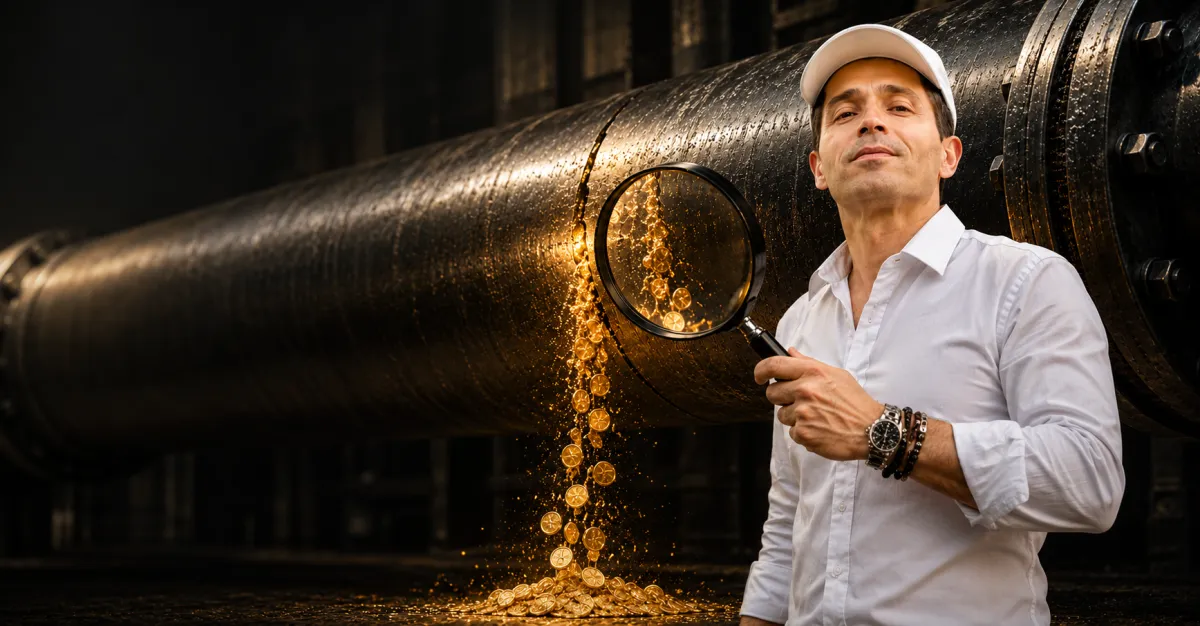
Now let's talk about the part nobody puts on a dashboard: hidden profit leakage.
Most leakage in a recycling operation is invisible, because it never shows up as a loss. It shows up as an absence — money that should have been there and quietly wasn't. You can't see it on a P&L, which is exactly why it persists for years.
Undervalued material. Many operators don't actually know what they have. Not precisely. They know it by category — "that's mixed plastic," "that's e-waste," "that's ferrous." But they don't know the true composition, the real contamination level, or the actual downstream applications the material could serve. So they price it as a category and sell it as a commodity, when parts of that stream might qualify for a far higher-value use. That gap between what a material is and what you think it is — that's material intelligence, and weakness there is one of the biggest silent margin killers in the sector.
Missed downstream opportunities. Every time material moves to the easiest buyer instead of the best buyer, margin leaks. The easy buyer is convenient. The best buyer takes work to find, qualify, and secure. Most operations default to easy because they're built for throughput, not for placement — and they eat the spread every single load without ever booking it as a loss.
Poor separation economics. Not too little sorting — the wrong sorting. Investing to separate material to a grade the market doesn't reward, while under-separating the fraction that actually commands a premium. Effort spent in the wrong place looks like productivity and costs like waste.
Weak buyer networks. If you have one or two buyers per stream, you don't have a market — you have a dependency. And dependency is priced against you every time you negotiate, because the buyer knows you have nowhere else to go. A thin buyer network doesn't just cap your upside; it hands your pricing power to someone else.
Add these up across a year of tonnage and the number is rarely small. It's often the difference between a recycling line that "washes its face" and one that actually funds the business.
Who wins the next decade
Here's where this goes, and it's worth thinking about carefully, because the winners of the next ten years in this industry are not going to be who most people assume.
They will not be the biggest collectors. Collection is a route-density game that's already been won in most markets.
They will not simply be the best processors. Processing is becoming table stakes — necessary, replicable, and increasingly commoditized.
The companies that win will be excellent at four things, and these four are where the real defensibility lives:
Material intelligence. They will know precisely what they have — composition, contamination, and the full range of applications and values — better than anyone else touching that stream. Information asymmetry is margin. In a commoditized industry, knowing more about your own material than your buyer does is one of the last durable edges.
Downstream market creation. They won't wait for buyers to exist. They'll build demand — developing offtake relationships, qualifying new applications, and creating markets where fragile ones stand today. The operator who controls demand controls price, and the operator who controls price controls the business.
Ecosystem orchestration. Remember Robert's point. The winners will align the producer, transporter, processor, buyer, and regulator around shared value instead of fighting over a fixed and shrinking slice. Orchestration is a role, and it's the most valuable one in any fragmented chain — because the party that aligns everyone else captures the value that used to leak in the gaps.
Monetization. They will treat every stream as an asset to be priced, positioned, and sold with intent — not a byproduct to be moved off the yard as cheaply as possible. That single reframe, from disposal cost to sellable asset, is the whole game.
None of these are sorting-line upgrades. They're strategic capabilities. And they compound — which means the gap between the operators who build them and the ones who don't is going to widen every year, not narrow. This is the part most owners haven't priced in yet.
The reframe
So let me put the whole thing in one line.
Recycling doesn't need to be fixed. It needs to be repriced — by the operators running it.
The technology is not your bottleneck. Commodity prices are not your destiny. Your bottleneck is the economics you've built around the material: who you sell to, what you actually know about what you have, and how much value is leaking through the gaps in your ecosystem before it ever reaches a buyer.
If you've read this far and something has been nagging at you — a suspicion that your operation is leaving money on the table you can't quite locate — trust that instinct. It's usually right. The value is almost always already inside the streams you're handling today. The problem is that nobody has mapped where it's leaking out.
If you think profit is leaking in your operation
That's the first thing to find out — not whether there's hidden value in your material, but where it's escaping before you capture it.
That's exactly what the Waste Stream Profit Diagnostic is built to do: locate the specific points where margin is leaking out of your existing operation, before you spend another dollar on equipment or chase another commodity cycle.
It starts with a short prequalifying call. Not a pitch — a filter. It's there to confirm whether there's enough at stake in your material streams to justify going deeper. If there is, we'll map exactly where the leakage lives. If there isn't, I'll tell you that too.
If you suspect profit is escaping somewhere inside your waste or recycling operation, and you'd rather find it than keep guessing, book a preliminary consultation.
The material is already yours. The only question is how much of its value you're actually keeping.
To Your Success
Sam Barrili
The Waste Management Alchemist