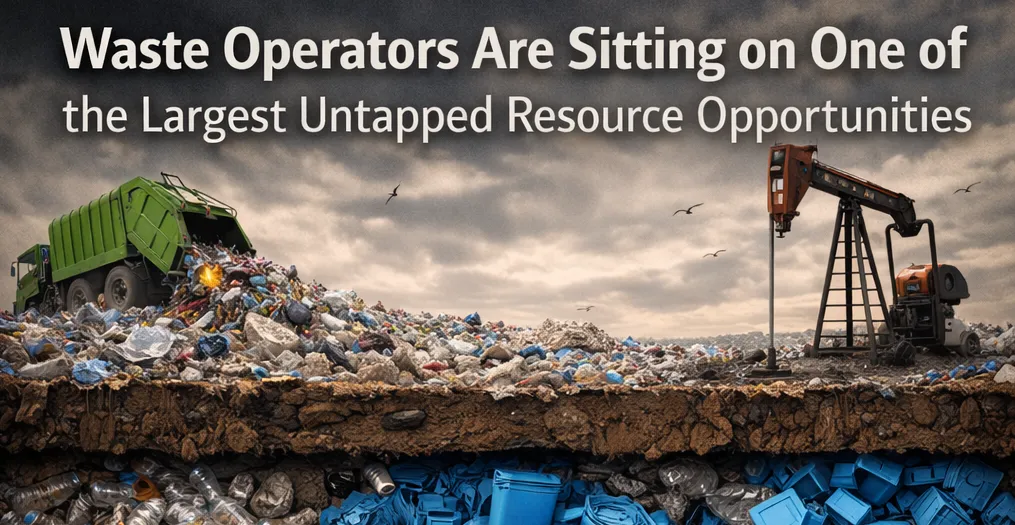
What Really Happens to Plastic Waste in the United States
And Why Waste Operators Are Sitting on One of the Largest Untapped Resource Opportunities
If you walk into a supermarket anywhere in the United States, you will see thousands of products packaged in plastic.
Bottles.
Food containers.
Plastic film.
Packaging foam.
Now here’s a question that very few people ever stop to ask.
How much of that plastic will actually be recycled?
Most people assume the answer is simple.
“Most of it.”
After all, the recycling symbol appears almost everywhere.
But if you work inside the waste management industry, you know the reality is very different.
The truth is that plastic recycling in the United States is not one system.
It is seven completely different materials, each with its own economics, infrastructure, and market demand.
And once you understand that difference, something very interesting becomes clear:
Only a small portion of plastics is actually recycled at scale.
The rest?
Most of it is buried in landfills, burned, or exported.
But hidden inside that failure lies one of the largest business opportunities in the waste management sector today.
The Plastic Recycling Illusion
From the consumer’s perspective, plastics look almost identical.
A yogurt cup, a water bottle, and a grocery bag all appear to belong to the same material family.
But from an industrial perspective, they are completely different commodities.
Plastics are categorized using seven resin identification codes, the small numbers you see inside the recycling triangle.
These codes represent entirely different polymers.
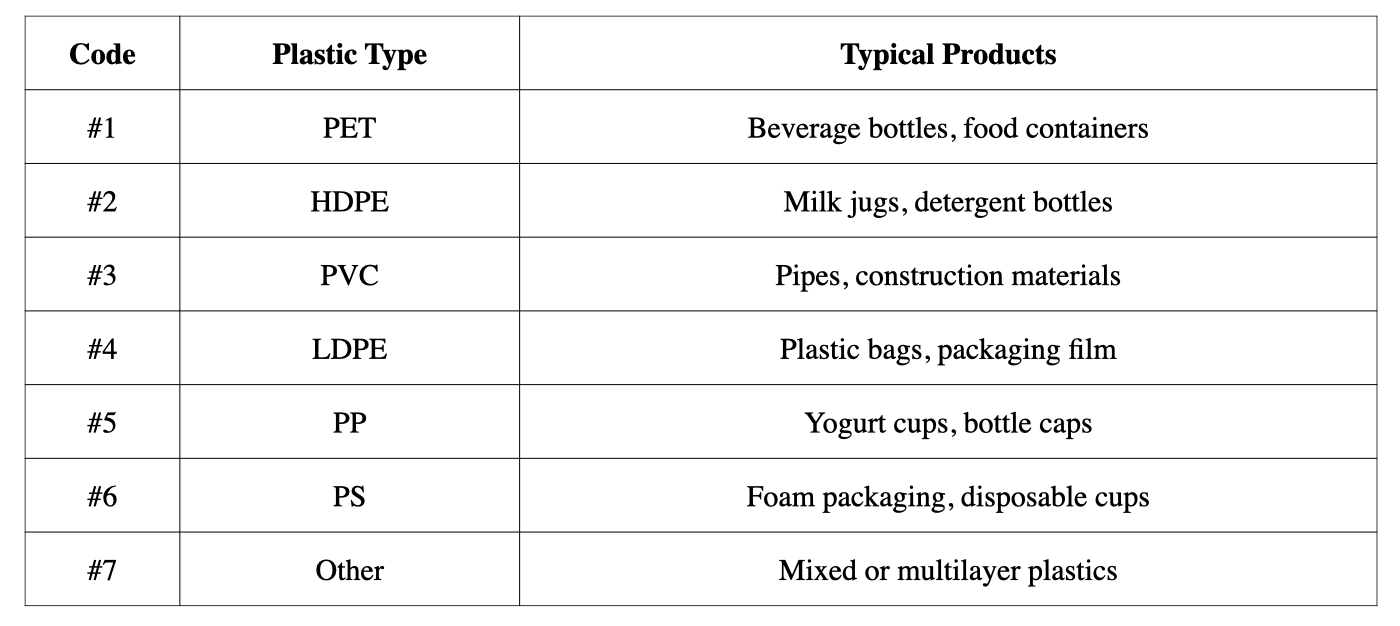
From the perspective of waste management infrastructure, each of these plastics behaves differently.
Some can be recycled economically.
Most cannot.
The One Plastic That Actually Works
Among these seven plastics, one material stands out.
PET (#1).
PET is the plastic used in beverage bottles and many food containers.
In the United States, PET recycling works because three critical conditions are present:
• High collection volumes
• Established recycling infrastructure
• Stable industrial demand
The recycling rate for PET bottles in the U.S. usually ranges between 28% and 30%.
That number might not seem impressive.
But within the plastic recycling industry, it is actually considered a success story.
Because once we move beyond PET, the situation changes dramatically.
The Second Tier: HDPE
The next plastic with meaningful recycling activity is HDPE (#2).
HDPE is commonly found in products such as:
• Milk jugs
• Laundry detergent bottles
• Shampoo containers
Like PET, HDPE benefits from:
• predictable supply streams
• stable polymer quality
• established end markets
Recycling rates typically fall between 20% and 30%.
But once we move beyond PET and HDPE, the economics become far more challenging.
The Plastics That Rarely Get Recycled
Many plastics are technically recyclable.
But economically, they often are not.
PVC (#3)
PVC is widely used in construction materials such as pipes and vinyl products.
However, recycling PVC is extremely difficult because the material contains numerous additives that contaminate other plastic streams.
As a result, recycling rates are extremely low.
Most PVC ends up in landfills.
LDPE (#4)
LDPE is used in plastic bags and packaging films.
This material presents major challenges for recycling facilities.
Flexible plastics can clog sorting equipment and are difficult to separate efficiently.
As a result, most LDPE is not recycled.
Polypropylene (#5)
Polypropylene is used in yogurt containers, caps, and many types of food packaging.
Although technically recyclable, many material recovery facilities historically did not separate polypropylene due to low market value.
Only recently have some systems begun recovering it.
Recycling rates remain limited.
Polystyrene (#6)
Polystyrene is the foam used in disposable cups, takeout containers, and protective packaging.
It is one of the least recycled plastics in the system.
The material is extremely lightweight, which makes transportation expensive relative to its value.
For this reason, many municipalities simply exclude it from recycling programs.
Other Plastics (#7)
The final category includes mixed and multilayer plastics.
These materials are common in modern packaging, where different polymers are combined to create protective barriers for food products.
Unfortunately, separating these materials is extremely complex.
Recycling rates are therefore almost negligible.
The Real Numbers Behind Plastic Recycling
When all plastic categories are combined, the overall recycling rate for plastics in the United States is typically around:
8–9%.
That means more than 90% of plastic waste is not recycled.
Instead, it is sent to:
• landfills
• incinerators
• export markets
• unmanaged disposal streams
From an environmental perspective, this represents a major challenge.
But from a business perspective, it represents something else entirely.
A massive untapped resource stream.
The Hidden Opportunity Waste Operators Often Miss
When I speak with waste management companies across the United States, I often hear the same statement.
“Plastic recycling doesn’t work.”
But that statement is only partially correct.
What doesn’t work is the traditional waste management model.
For decades, the industry has operated under a very simple structure:
Collect
Compact
Transport
Landfill
It is a straightforward system.
But economically, it leaves enormous value behind.
The companies that are succeeding today operate differently.
They view waste not as a disposal problem…
But as a resource supply chain.
Plastic Waste Is Actually Stored Energy
Most plastics originate from petroleum.
Which means they contain significant energy content.
In fact, many plastic polymers have calorific values comparable to diesel fuel.
This opens the door to entirely different resource recovery pathways.
Plastic waste can be transformed into:
• synthetic fuels
• chemical feedstocks
• industrial energy sources
Technologies such as pyrolysis, gasification, and solid recovered fuel production are increasingly used to unlock this value.
The Urban Mining Perspective
Around the world, cities are increasingly being viewed as resource deposits.
Inside municipal waste streams we find enormous quantities of materials:
• metals
• plastics
• rare earth elements
• critical minerals
Instead of extracting these resources from the ground, modern waste systems are beginning to recover them from the urban environment.
This approach is often referred to as urban mining.
And it is rapidly becoming a strategic priority for many countries.
Secondary raw materials are increasingly recognized as critical assets for economic growth and industrial security.
How Secondary Raw Materials Wil…
At the same time, geopolitical tensions are disrupting global supply chains for many raw materials.
Commodities and Geopolitcal Risk
In that context, waste streams begin to look very different.
They start to resemble domestic resource reserves.
Why Smaller Waste Companies May Have an Advantage
Large waste corporations dominate the logistics side of the industry.
But smaller operators often have a major strategic advantage.
They are more flexible.
Small companies can experiment with new recovery models much faster.
For example:
• specialized plastic collection programs
• targeted material recovery services
• partnerships with niche industrial buyers
These initiatives can open entirely new revenue streams.
And they often require far less capital than large-scale processing infrastructure.
The Shift Toward Resource Management
The most forward-looking companies in the waste sector are no longer positioning themselves as waste haulers.
They are positioning themselves as resource management companies.
This shift begins with a simple change in perspective.
Instead of asking:
“Where can we dispose of this material?”
They ask:
“Who needs this material as a resource?”
That question fundamentally changes how waste systems are designed.
Collection becomes the first step in a much larger value chain.
The Waste Alchemy Perspective
For years I have used the term Waste Alchemy to describe this transformation.
Alchemy historically referred to the attempt to turn base materials into gold.
In modern waste management, the concept is surprisingly similar.
We take materials that society considers worthless…
And transform them into valuable industrial commodities.
But this transformation requires three things:
• technical understanding
• strategic logistics
• market connections
When those elements come together, waste streams begin to look very different.
They stop being a cost.
And they start becoming a source of revenue.
A Final Thought
Every day in the United States, millions of tons of plastic move through waste management systems.
Most of it is buried.
Some of it is burned.
Very little of it is truly recovered.
But inside that stream lies a powerful opportunity.
For waste operators.
For entrepreneurs.
For companies willing to rethink how materials move through the economy.
Because once you begin looking at waste through the lens of resource management, something changes.
You stop seeing trash.
And you start seeing commodities.
If you are interested in exploring how waste streams can be transformed into new revenue sources, I explain these strategies in detail in my book:
It outlines the frameworks waste operators can use to identify hidden value inside materials that most companies still treat as disposal problems.
Because in the right system…
Waste is not the end of the value chain.
It is the beginning of a new one.
To Your Success
Sam
The Waste Management Alchemist