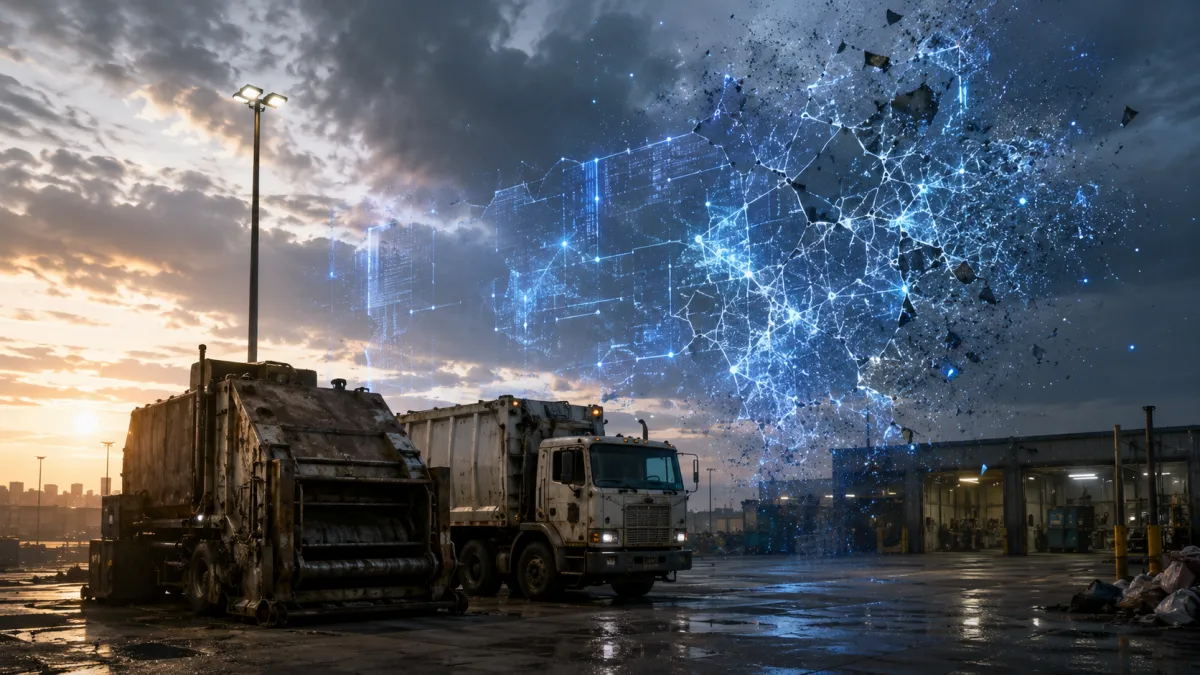
AI Won't Save Your Waste Company. Here's What Will.
Let me tell you something nobody in the tech world wants you to hear.
AI is not coming to save your waste business.
Not this year. Not next year. And probably not in any version that makes economic sense for a company your size.
I know that stings. Because everywhere you look — conferences, LinkedIn posts, webinars from people who have never stepped foot inside a transfer station — the message is the same: "AI is the future of waste management."
And here's the thing. They're not entirely wrong.
AI can help waste management companies. It can optimize routes. It can improve sorting. It can predict equipment failure before it happens.
But there's a massive gap between what AI can do and what AI will do for your company. And that gap is measured in dollars you don't have and technology that won't sit still long enough for you to use it.
Let me explain.
The Real Cost Nobody Talks About
You run a small waste management company. You know what your equipment looks like. I know what your equipment looks like. Let's not pretend.
Most small operators in this industry are running trucks, balers, sorters, and compactors that were built to last — and they have lasted. Some of that equipment is 10, 15, even 20 years old. It works. It's paid off. It does the job.
Now somebody walks in and tells you: "Just integrate AI into your operations."
Okay. With what?
AI-driven sorting systems need sensors, cameras, data infrastructure, and processing power that your current setup was never designed to support. You can't bolt artificial intelligence onto a 2008 baler and expect miracles.
To make AI work, you would need to replace the equipment it needs to interface with. And we're not talking about a software subscription here. We're talking about a full capital overhaul — new machinery, new sensors, new data pipelines, new maintenance contracts.
For a small operator? That's not an upgrade. That's a second mortgage on your business.
The Update Trap
But let's say you find the money. Let's say you take the leap. You invest $200,000, $500,000, maybe more into AI-enabled systems.
Here's what happens next.
Three months later, the technology updates. The model you bought is now last generation. The software needs a patch. The algorithm got smarter — but only if you buy the new version.
Six months later, the hardware vendor announces a new sensor array that makes your current setup look like a flip phone.
A year later? You're already behind again.
This is the reality of AI right now. It is moving so fast that the technology you buy today is outdated before you finish paying for it.
Every week — and I'm not exaggerating — every single week, there is a new development, a new model, a new platform, a new update that shifts the landscape. For the big players, the waste conglomerates with billions in revenue, that's fine. They have R&D departments. They have capital reserves. They can absorb the cost of constant iteration.
You don't.
And nobody telling you to "adopt AI" is going to cover the bill when that shiny new system needs replacing 18 months from now.
The Uncomfortable Math
Let me put it simply.
If you're a small waste management company generating $1 million to $5 million in revenue, the cost of implementing AI at a level that actually moves the needle will eat into your margins so aggressively that you'll be less profitable than you were before.
Read that again.
The thing that's supposed to make you more competitive could actually make you weaker — because you'll be bleeding cash on technology while your fundamentals stay exactly the same.
And that's the part that really matters. Because your real problem was never about technology.
Your Real Problem
Here's what I've seen in 15+ years of working with waste companies across the US and Europe.
The operators who struggle are not struggling because they lack AI. They're struggling because they don't understand the value of what they already control.
They look at the waste on their trucks and see tonnage. They see volume. They see something to move from Point A to Point B as fast and as cheaply as possible.
They don't see the secondary raw materials sitting inside those loads. They don't see the aluminum, the copper, the plastics, the organics, the recoverable fractions that someone downstream is willing to pay real money for.
They don't control their input streams. They don't structure their output. They don't know what their waste is actually worth — because nobody ever taught them to think about it that way.
That's the gap. Not a technology gap. A thinking gap.
And no amount of AI will close a thinking gap.
What Actually Moves the Needle
I didn't write The Waste Alchemy because I thought the industry needed another textbook. I wrote it because I watched too many small operators get crushed — not by competition, not by regulation, not by technology — but by their own failure to see what they were sitting on.
The book is built around one central idea: waste is not a liability. It is a misunderstood asset.
Inside The Waste Alchemy, I break down the frameworks that allow small and mid-sized waste companies to:
Identify what's actually inside their waste streams — not in theory, but in practice, with real numbers and real categories that translate directly into revenue.
Control incoming material — because the company that controls what comes in controls what goes out, and what goes out determines whether you make money or just move trucks.
Monetize secondary raw materials — by understanding who buys what, at what grade, at what price, and how to structure your operations so those materials reach the market in a form that commands value.
Build a business model that doesn't depend on volume alone — because the hauling game is a race to the bottom, and the companies that survive the next decade will be the ones who stopped playing it.
None of this requires AI. None of this requires a $500,000 capital investment. None of this requires you to keep up with a technology cycle that changes faster than you can write the check.
What it requires is a shift in how you see your own business.
The Choice
You have two paths in front of you right now.
Path one: Keep listening to the AI hype. Keep waiting for the technology to get cheap enough, stable enough, simple enough for a company your size to use. Keep watching the big players adopt tools you can't afford while the gap between you and them grows wider every quarter.
Path two: Start extracting value from what you already have. Learn the economics of your own waste streams. Build margin where you're currently losing it. Turn your operation from a truck-based business into a material-based business — and do it with the equipment, the people, and the infrastructure you already own.
One path costs you years and money you don't have. The other costs you a book and the willingness to think differently about what you do every day.
The Waste Alchemy is available now on Amazon.
Get your copy here: https://bit.ly/4sQt4LQ
The companies that win in this industry won't be the ones with the best technology. They'll be the ones who understood, before everyone else, that the value was in the material all along.
Stop waiting for AI to save you.
Start seeing what's already yours.
To Your Success
Sam Barrili
The Waste Management Alchemist