Articles
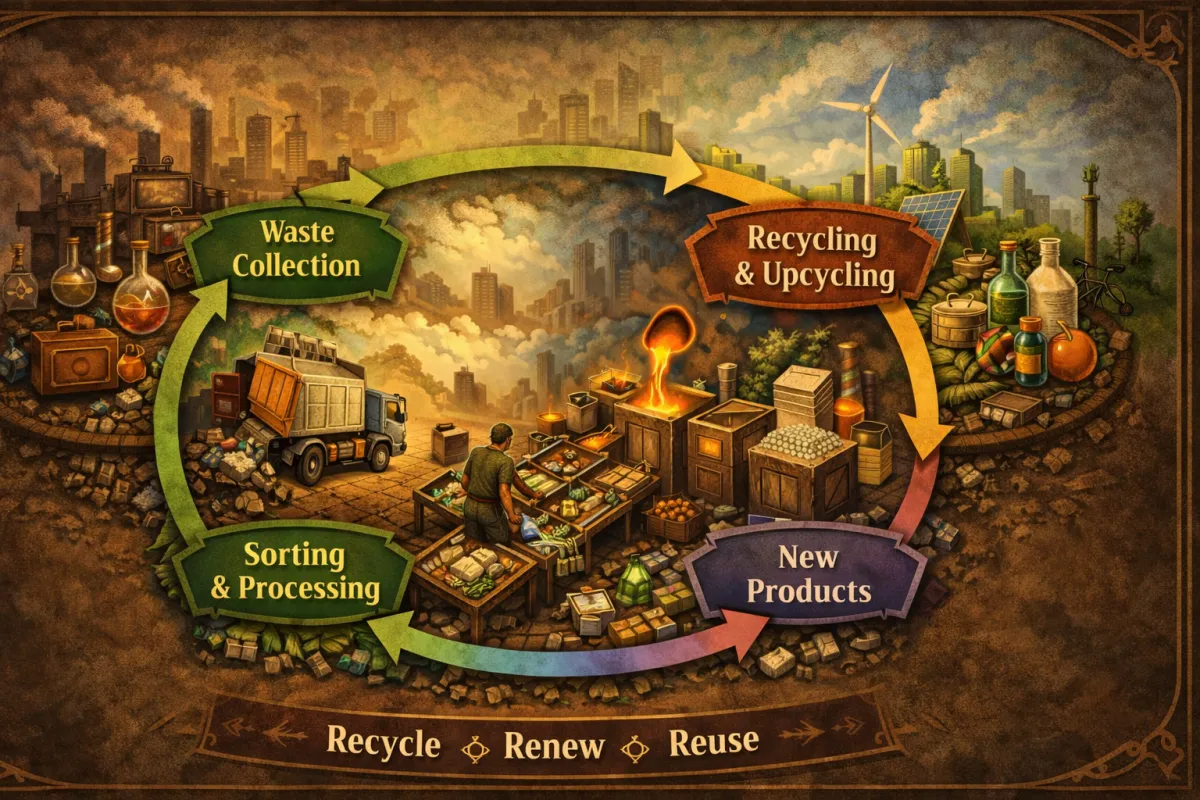
The Recycling Loop Nobody Closes — And the Margin Inside It
Most of the recycling happening right now is a lie.
Not in the sense that materials aren't being sorted. They are. Not in the sense that trucks aren't picking things up and facilities aren't processing them. They are. The lie is more precise than that: the loop never closes.
Materials get separated, baled, and shipped — often hundreds or thousands of kilometers away — to end users who have no relationship with the territory where the waste was generated. The local manufacturers who consume paper, plastic, metal, and glass keep buying virgin raw materials from global supply chains because nobody has organized a local alternative. The waste company keeps selling to spot markets and brokers because that's the only commercial structure it has.
In between, value leaks in every direction. Transport costs eat the margin. Commodity price swings destroy the economics. The "recycled" material often travels farther than the virgin material it was supposed to replace. And the territory — the industrial district, the city, the region — sees no structural benefit from the materials it generates.
This is the dominant model in waste management today. It's also exactly why most recycling operations are financially fragile, strategically weak, and invisible to the local industrial ecosystem they could be serving.
The companies that are going to dominate the next decade are building something structurally different. They are closing the loop locally. And they're doing it through a specific kind of relationship-building that most waste operators have never started.
What Real Recycling Actually Requires
Recycling, as a concept, is simple: a material goes back into a production cycle instead of being destroyed or buried. The problem is that most of what we call recycling today doesn't do that. It ships the material somewhere and then stops tracking it.
True recycling has a clear structural requirement: the material must re-enter a production process. That process can be anywhere in theory, but in practice, the closer it is to where the material was generated, the more viable and commercially durable the whole system becomes.
Proximity matters for three specific reasons, and none of them are ideological.
First, logistics costs are the primary enemy of recycling economics. The moment a secondary raw material has to travel more than a few hundred kilometers to reach its end user, the cost structure changes. Transport eats the margin. If the material was already low-value to begin with — mixed plastics, contaminated glass, certain paper grades — a long transport chain makes the entire operation economically marginal or worse. This is why so much recycled material ends up in landfill or incineration anyway. Not because treatment failed. Because the commercial chain couldn't absorb the transport cost.
Second, quality control is easier to maintain over short distances. The closer you are to your buyer, the faster you can adjust your sorting standards, respond to specification changes, and build the kind of trust that supports premium pricing. Long-distance commodity selling doesn't allow for that feedback loop. You're just another supplier in a broker's portfolio.
Third, and most importantly: a local industrial relationship is structurally more stable than a spot market. If you have three manufacturers in your territory that consume the secondary raw materials you produce, you have three buyers with stable, predictable demand — buyers who can't easily switch to alternative suppliers the moment commodity prices shift. You have pricing leverage, operational predictability, and a commercial position that doesn't collapse every time a global commodity market corrects.
This is the foundation of the local loop model. Not a sustainability narrative. A commercial logic built on proximity, stability, and structural advantage.
EPR Is Coming — and the Operators Who Win Are Already Ahead of It
Extended Producer Responsibility — EPR — is the regulatory framework that transfers the cost and obligation of end-of-life material management from the public sector to the companies that put products into the market. In plain terms: if you manufacture a product and it eventually becomes waste, you are legally and financially responsible for what happens to it.
EPR is expanding fast. The EU has been rolling it out across product categories for years — packaging, electronics, batteries, textiles, vehicles. The list keeps growing. In the United States, state-level EPR legislation for packaging is accelerating significantly. Italy, Portugal, Spain, Germany, France — all tightening and broadening the framework. The direction is unambiguous regardless of which market you're in.
For waste management companies, this creates a strategic inflection point.
On one side: the traditional hauler who waits for regulation to dictate what to do and prices accordingly. On the other side: the operator who reads the trajectory and builds, right now, the commercial relationships that EPR will eventually force everyone to have.
What EPR fundamentally demands is a verifiable connection between producers and end-of-life processors. A producer enrolled in an EPR scheme needs to know that the materials they put into the market are actually being recovered and reintegrated into production cycles. They need documented proof, verified recovery rates, and auditable chains of custody. They need a partner — not just a service provider who picks up the bill and files a form.
The waste company that builds a direct relationship with local producers before EPR forces the issue is in an entirely different commercial position. It already has the trust. It already has the data. It already has the operational infrastructure. When compliance pressure arrives, it becomes indispensable. Its competitors scramble to build in three years what this operator spent three years quietly assembling.
There is a second layer here that most operators miss. EPR schemes don't just create demand for recycling services — they create demand for local recycling services. A producer trying to demonstrate compliance with territorial recovery targets needs local operators who can provide verified, documented local recovery. An operator a thousand kilometers away can't serve that compliance need as effectively as one embedded in the same territory.
Geographic proximity to the producer isn't just a logistical convenience. Under EPR frameworks, it becomes a compliance asset.
If you want a deeper look at how secondary raw materials function as strategic business assets rather than disposal outputs, this article on the secondary raw materials business opportunity lays out the core economic logic in detail.
How to Build the Local Industrial Network
This is where strategy becomes operational. The concept is clear. The harder question is: what do you actually do to build this network?
It starts with a mapping exercise that most waste companies have never done. The question is simple: which companies in your territory consume materials that you produce, or could produce with targeted investment?
Take each secondary raw material stream you handle. For each one, work through three questions:
- What specification does this material reach at the end of your current process?
- What industrial production processes consume material at or near that specification?
- Which companies operating in your territory run those processes?
This exercise — done rigorously — will produce a list of potential local buyers you have probably never spoken to. Not commodity brokers. Not distant exporters. Actual manufacturers who buy input materials daily, and who currently source them through supply chains that don't include you.
The conversation you need to have with these companies is not the conversation waste management companies typically have. You are not calling to offer a collection or disposal service. You are calling to discuss a material supply relationship. The framing shifts entirely: from "we take your waste" to "we can supply your production input."
That is a completely different commercial conversation — and it leads to a completely different kind of agreement, with different pricing dynamics, different contract structures, and different relationship depth.
Consider what this looks like in practice. A manufacturer who can source recycled PET flakes locally, at a reliable and consistent specification, from a supplier they have a direct relationship with, does not need to source virgin resin from a global commodity market. A metal fabricator who can access secondary aluminum locally doesn't need to wait for commodity prices to align in their favor. A packaging manufacturer that can source clean, sorted fiber locally can reduce its dependence on imported pulp and position itself as a more compliant buyer in an increasingly EPR-constrained market.
These relationships don't happen automatically. They require a waste company that understands the buyer's production requirements in enough detail to adjust its own processing operations accordingly. They require investment in reaching the right material specifications. They require the commercial infrastructure to support stable, documented supply agreements rather than ad hoc spot transactions.
That is what separates a waste company from a resource company. And that distinction is what the entire modern waste company model is built around.
For a deeper look at how this plays out with plastic streams and what the secondary materials market actually requires from processors, this article on plastic waste and secondary raw materials gets into the material-level thinking this approach demands.
The Commercial Architecture This Creates
Let me be specific about what changes when you close the local loop, because the commercial implications are substantial and they compound over time.
You shift from price-taking to price-setting. In a commodity market, your secondary raw materials are priced by forces entirely outside your control. You take what the buyer offers or you don't sell. In a local supply relationship, price is negotiated based on the specific value you deliver to a specific buyer's production process. The negotiation is bilateral, informed by both parties' costs and needs, and it typically produces better economics for the seller who has done the work to understand the buyer's position.
Demand becomes predictable and plannable. A manufacturer who sources from you on an ongoing basis has a production schedule. That schedule translates into predictable material pull. Predictable material pull allows you to run your processing facility more efficiently, reduce storage and inventory costs, and build your intake strategy around a real demand signal rather than a guessed market appetite. The entire operational logic of your facility becomes cleaner when you have genuine downstream certainty.
Your intake strategy sharpens. Once you know exactly what specification a local buyer needs — and what volume they consume — you can work backwards through your entire operation. You know which incoming waste streams to prioritize in your collection agreements. You know what sorting quality to target. You know which waste producers in your territory are worth building relationships with because their material composition aligns with your downstream buyer's requirements. The buyer relationship doesn't just create revenue. It creates operational focus.
You become structurally embedded in the local industrial economy. A waste company that handles collection and disposal is a service provider and is, in principle, replaceable. A resource company that supplies critical production inputs to local manufacturers is a strategic partner in those manufacturers' supply chains. The switching cost is high. The relationship has depth. The interdependence is real and mutual. When regulatory or market conditions shift, that positioning is worth considerably more than a collection contract.
This is the commercial architecture of the modern waste company. It's not a more efficient version of the old model. It's a fundamentally different structural position in the local economy — one with different margins, different relationships, and different long-term resilience.
If you want to understand the macro-level forces driving the strategic importance of secondary materials — including the growing deficits in critical industrial metals and why that matters for waste operators — this article on secondary raw materials and global resource deficits provides useful context.
There's a practical entry point worth noting here. You don't need to transform the entire operation overnight. You start by identifying one or two high-value material streams where you're already producing something close to buyer-specification quality. You find one or two local industrial buyers for those streams. You build one real supply relationship and understand everything that relationship requires operationally. Then you expand. The architecture is built deal by deal, stream by stream.
If this is the direction you want to move — book a free 20-minute call and let's look at where your operation sits today and where the first local loop opportunity is.
The Course That Builds This Systematically
In the middle of April, I am opening the Modern Waste Companies course on Skool.
This is not a course about recycling theory, regulatory compliance frameworks, or sustainability reporting. It is a structured operational and commercial program for waste company owners and operators who want to build exactly what this article describes: a resource business with real local roots, stable downstream relationships, and a commercial architecture that produces margins the traditional hauling model is structurally incapable of reaching.
The course covers stream analysis and material flow mapping, downstream network development, local buyer relationship building, EPR positioning strategy, and the full commercial restructuring that transitions a waste company into a modern resource company. The content is built on the same methodology I have used working with operators across Europe, the US, and emerging markets — the SAM Method, applied at full depth.
If you have been reading this article and recognizing the gap between where your operation is today and where the model described here would take it, the course is for you. If you run a waste operation and you want to stop competing on service pricing and start building the kind of structural position that creates real leverage — this is the most direct path I know of.
Details and registration will open in mid-April. If you want early access information, book a call now and let me know you're interested: https://sambarrili.com/schedule-free-20min-call
The Territory Doesn't Need Another Hauler
It needs a company that understands what materials move through it, what value those materials carry, and how to connect the producers who generate them with the industries that need them as inputs.
That is a role that no logistics company, no commodity broker, and no EPR compliance scheme can fill on its own. It requires a waste operator with the technical knowledge to process materials to specification, the commercial intelligence to identify and develop local buyer relationships, and the strategic vision to position itself as a structural part of the local industrial economy rather than a peripheral service to it.
The companies building this now are not waiting for regulatory pressure to force the move. They are assembling the structure before the urgency arrives — and that is exactly why they will be positioned to lead when the market catches up with where they already are.
Close the loop. Locally. That's where the real margin lives.
Ready to start building a modern resource company from your existing waste operation?
- Book a Free 20-Minute Intro Call → https://sambarrili.com/schedule-free-20min-call
- Get the foundational framework: The Waste Alchemy → https://bit.ly/4sQt4LQ


Sam Barrili
I'm known as the go-to guy for talking about business strategies and growth strategies for waste management companies.
I started my journey in this field in 2009 when I finished my degree in Toxicological Chemistry and joined a wastewater treatment company to develop its market.
Since then, I helped dozens of waste management companies in America and Europe increase their annual profits by over 25 million dollars thanks to my SAM Method.
If you want to know if I'm a good fit for you, read an article or watch a video.
If you find it helpful, I’m probably a good match.
If not, that's OK too.
Call +1 (727) 307-2695
Email: [email protected]


